

Welcome to Module 1: ADHD at Work: Thriving in Business & Beyond
This module is designed to help you understand ADHD not as a limitation, but as a unique way of thinking, creating, and engaging with the world
Core Objectives
By the end of this module, you will be able to:
- Understand how ADHD affects executive functioning, focus, and organization in fast-paced business environments.
- Recognise your unique ADHD strengths—such as creativity, resilience, and hyperfocus—and learn how to leverage them for a competitive edge.
- Adopt neuroaffirmative language to reframe your identity and stop battling outdated "deficit" narratives.
- Apply practical, brain-friendly strategies to support time management, task initiation, and sustained energy.
- Design a sustainable physical workspace and daily routine that prevents burnout and promotes deep work.
General Overview & Objectives of the Module
In this unit, we explore how ADHD presents in real workplace and learning environments, and why traditional systems can be challenging for ADHD brains. Adults with ADHD often experience differences with sustained attention, time management, organisation, and impulse control (6 areas of executive functioning).
For example, repetitive tasks or rigid procedures may lead to disengagement; while stimulating or meaningful work can unlock deep focus and productivity. Research shows that workplace challenges are often linked not to lack of ability, but to a mismatch between neurodivergent thinking styles and conventional expectations.
ADHD is characterised by interest-based attention: engagement increases when tasks are stimulating, urgent, or meaningful. Understanding this helps reframe challenges or differences as context-dependent rather than personal shortcomings. This unit introduces a neuroaffirmative perspective viewing ADHD as a difference with both challenges and strengths and lays the foundation for strategies explored later in the module.
By the end of Module 1, you’ll have a clearer understanding of your brain, a more affirming way of speaking about yourself, and a growing toolkit for navigating business and life with greater confidence, alignment, and care.
Unit 1: Understanding ADHD at Work
Shift from deficit-based labels to neuroaffirmative language.
Understand your specific ADHD presentation and how co-occurring conditions shape your unique entrepreneurial journey.
Unit 1: Understanding ADHD at Work
Unit 2: Leveraging ADHD Strengths
Map how your brain's "GPS system" handles focus, memory, and motivation.
Identify where your executive functions naturally shine and where they need external support.
Unit 3: Recognising Internal Resources
Stop fighting your brain.
Reframe traditional "weaknesses" into your greatest business assets,such as rapid innovation and resilient problem-solving.
Unit 3: Recognising Internal Resources
Unit 4: Strategies for Sustainable Work
Build a personalized "Strategy Stack." Learn how to use visual anchors, body doubling, and timed sprints to bypass willpower and make getting started effortless.
Unit 5: Inclusion & Long-Term Success
Design an environment that fits your neurocognitive style. Learn how to implement "Structured Flexibility" and visually zone your physical workspace for maximum focus
Unit 5: Inclusion & Long-Term Success



1.1. Understanding ADHD
This unit covers what ADHD actually is, how it shows up across three presentations, and why neuroaffirmative language is the foundation for everything that follows.
Learning Objective: Identify the three types of ADHD, understand co-occurrence, and apply neuroaffirmative language to reframe how you speak about yourself.
Case Example Introduction
Meet Alex — an entrepreneur running a freelance marketing consultancy. Alex is dynamic, full of creative ideas, and great in a crisis. But he often feels overwhelmed by administrative tasks, struggles with inconsistent energy, and constantly worries he is "disorganized." Throughout this module, you'll see how Alex stops fighting his brain and starts designing a business around it.
ADHD (Attention Deficit Hyperactivity Disorder) is a common neurodevelopmental variation that influences how a person’s brain processes information, attention, and energy. It's estimated to affect around 5–8% of children and adolescents, with many continuing to experience traits into adulthood sometimes receiving a diagnosis later in life.
The core traits of ADHD include differences in Attention, Impulsivity, and Activity levels. These traits are only considered ADHD when they significantly impact daily life in multiple areas, such as school, work, or relationships.
ADHD is often hereditary, meaning it can run in families. Rather than being a deficit, ADHD reflects a different way of experiencing and interacting with the world one that comes with both challenges and unique strengths.
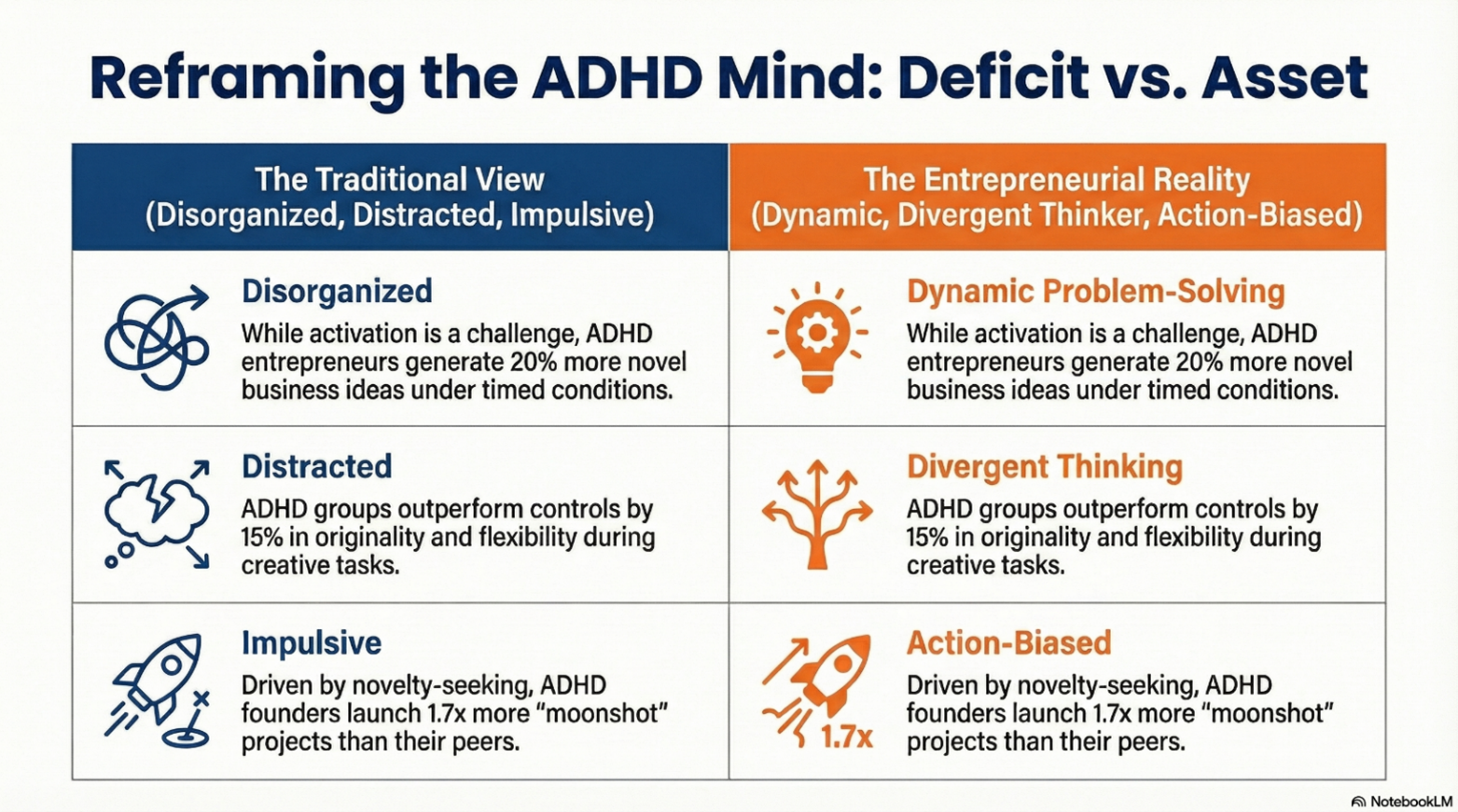
Fun Fact: 30% of entrepreneurs have ADHD, dyslexia, or both. University graduates with ADHD are twice as likely to start their own businesses. (UK ADHD Foundation)
Did you know that ADHD (Attention-Deficit/Hyperactivity Disorder) is classified into three types based on predominant symptoms:
- Predominantly Inattentive Type: Having trouble focusing on unstimulating tasks, forgetting or losing things, and struggling to organize daily routines. This type (formerly known as ADD) tends to go unrecognized, especially in women.
- Predominantly Hyperactive-Impulsive Type: Hyperactivity is the most prominent feature—having difficulty staying still, feeling internally restless, interrupting others, and acting on instinct

1.2. Co-occurrence: ADHD Rarely Travels Alone
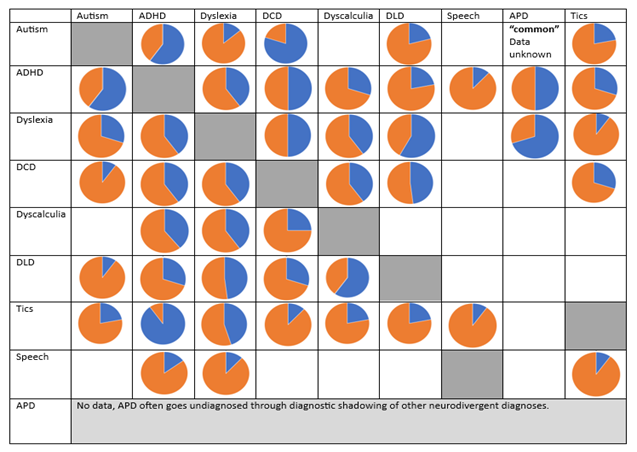
ADHD can co-occur with other neurodivergences. When we say co-occur we mean that more than one ‘neurodivergence’ has been found in a person existing at the same time. This happens at a very high rate with neurodivergences. It’s not always known due to the rigidity of single diagnosis pathways so individuals are unaware. The data on co-occurrence is still estimations for this reason.
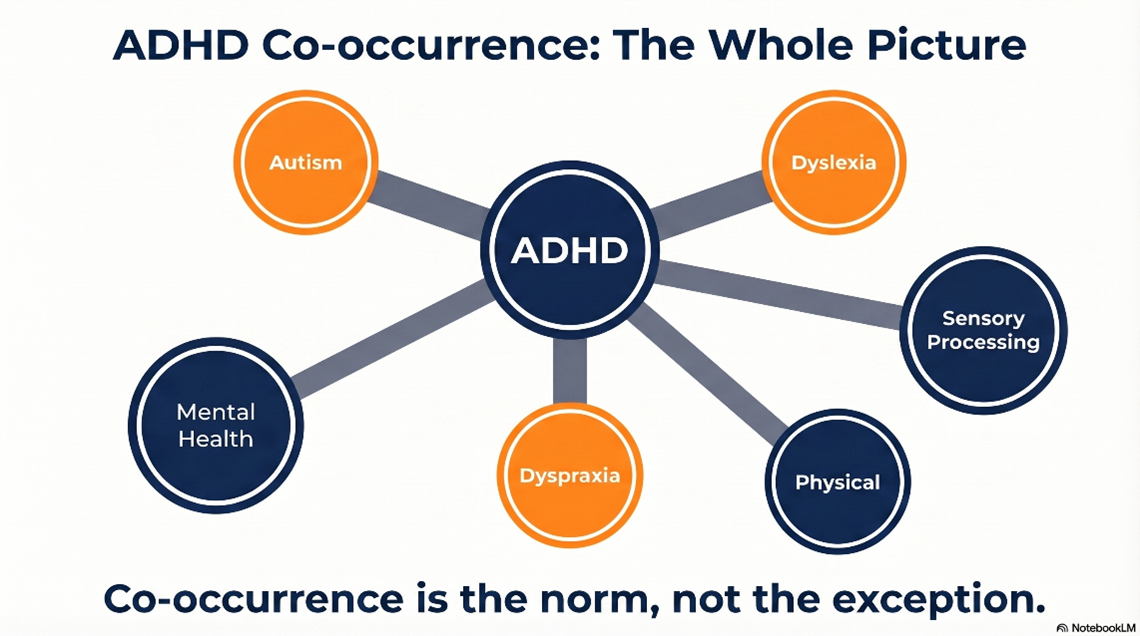
ADHD often overlaps with other forms of neurodivergence, such as autism, dyslexia, dyspraxia, or sensory processing differences. This is called co-occurrence. For entrepreneurs, recognizing co-occurrence helps create more tailored strategies rather than expecting a one-size-fits-all approach.
The below image illustrates that rate at which various neurodivergences can co-occur. The indicates the likelihood that the condition is occurring alongside the primary condition.
✍️TRY THIS NOW: The Language Check — ⏱️ 3 minutes Look at the deficit-based phrase: "I am too easily distracted." Write down your own neuroaffirmative reframe right now. (e.g., "My brain is a divergent thinker that scans for new opportunities.") You will use this reframe the next time you feel stuck.
1.4. Neuroaffirmative Language
Neuroaffirmative language is simply respectful communication that highlights your strengths and validates your lived experience. Instead of treating ADHD, autism, or dyslexia as problems to be "fixed" or "normalized," this approach focuses on practical support. By changing our language, we create environments where people feel seen, respected, and empowered to thrive exactly as they are.

Language shapes identity. Using deficit-based language (like calling yourself "lazy" or "scattered") creates barriers to self-advocacy. Neuroaffirmative language helps shift the focus from what's "wrong" to what’s "different"—allowing you to build on your strengths with dignity.
Alex Moment: Alex used to tell clients, "Sorry, I'm so scattered today, I'm just disorganized." This eroded their trust in him. He practiced shifting to neuroaffirmative language. The next week, he told a new client: "I am a big-picture thinker who pivots quickly. To ensure we don't lose the details, I rely heavily on written briefs." The client praised his self-awareness and professionalism.
For entrepreneurs or professionals, recognising co-occurrence can help create more tailored strategies that support how they work best, rather than expecting a one-size-fits-all approach.Understanding co-occurrence allows for more compassionate, accurate, and empowering support not just for challenges, but for the full range of neurodivergent strengths.
Fun Fact: Research shows that 30% of entrepreneurs have ADHD, dyslexia, or both, and university graduates with ADHD are twice as likely to start their own businesses (Lloyd, UK ADHD Foundation).
1.5. Additional Common co-occurring conditions
It's also important to remember that ADHD can co-occur with mental health conditions (like anxiety or depression), sensory processing differences, and other neurological conditions which can influence how someone experiences daily life, stress, and support needs. Being aware of this helps us respond with greater empathy, flexibility, and a more holistic understanding of the individual
ADHD often overlaps with other forms of neurodivergence, such as autism, dyslexia, dyspraxia, or sensory processing differences. This is called co-occurrence, and it’s more common than many people realise. Being aware of this is important because it helps us understand the full picture of someone’s experience.
Using deficit-based language can lead to misunderstanding, shame, and low self-esteem especially for people with ADHD and other neurodivergent profiles. When differences are constantly described as “problems,” “failures,” or “lacking,” it sends the message that someone is broken or not good enough. In contrast, neuroaffirmative language helps shift the focus from what's "wrong" to what’s different allowing people to feel respected, seen, and empowered to build on their strengths while managing challenges with dignity and clarity.
to neuroaffirmative language helps reframe ADHD not as a flaw to be fixed, but as a difference to be understood and supported.
1.6. Activity: Spot the narrative: Deficit vs Neuroaffirmative
Language shapes how we view ourselves and others. When we talk about ADHD, we often hear deficit-based language words that highlight what a person lacks or fails at. In contrast, a neuroaffirmative perspective acknowledges that brains work differently, not wrongly. It recognises strengths, values diversity in thinking, and avoids framing differences as flaws.
Activity Instructions:
Below are two short scripts. One uses deficit-based language, the other is neuroaffirmative.
Your task: Identify which is which and write in the box if its neuroaffirmative or deficit based and what the key words or phrases that gave it away.
Script A
"She/He/They never finish anything on time. She is always distracted, and it feels like she just doesn’t care. If she could just try harder and be more organised, she'd get more done."
Script B
"She works best when she's interested and thrives in fast-paced settings. While structured deadlines are tricky, she brings creativity and energy to projects that excite her."
1.7. Script 2: Entrepreneur Reflection
✍️ TRY THIS NOW: Spot the Narrative — ⏱️ 5 minutes
Activity Instructions:
- Identify which script is deficit-based and which is neuroaffirmative.
- Write the words or phrases of the language that helped you make your decision.
- Reflect on how each narrative affects how the speaker sees themselves and how others might see them.
Script A
"I’ve always struggled to stay consistent. I jump between ideas, and sometimes I feel like I’m just not cut out to run a business like other people. I forget things, miss deadlines, and it’s hard to stay focused unless something is really urgent. I know I need to be more disciplined if I want to succeed."
Identify which script is deficit-based and which is neuroaffirmative.
Write the words or phrases of the language that helped you make your decision.
Script B
"I’m an idea’s person. I naturally gravitate toward creative thinking and fast decision-making, which helps me pivot quickly in business. While structure and follow-through can be tough, I’ve learned to work with tools and collaborators who help balance my energy and keep projects moving. My brain works differently, and that’s part of what makes me good at what I do."
Identify which script is deficit-based and which is neuroaffirmative.
Write the words or phrases of the language that helped you make your decision.
✓ QUICK CHECK
- Can you name the 3 types of ADHD and one strength linked to each?
- Can you swap 3 deficit-based phrases for neuroaffirmative alternatives?
- → If yes, you are ready for Unit 2.
CORE INSIGHT ADHD is not a flaw to be corrected. It is a cognitive difference to be understood. Language is your first practical tool — and you can start using it today.
Unit 1 — Reflection Questions
- What messages — internal or external — have shaped how you view the way you work or focus?
- When do you feel most naturally "in flow" in your work?
- What is one neuroaffirmative phrase you could use about yourself starting this week?
Key Takeaways — Unit 1
- ADHD is a brain-based difference — not a deficit in value or ability.
- It comes in three types and often co-occurs with other conditions — strategies must be tailored.
- Shifting to neuroaffirmative language is your first and most immediate practical step.





Resource Name | Type | Link |
|---|---|---|
Structured App (Visual Day Planner) | App | |
Focusmate (Virtual Body Doubling) | Tool | |
TimeTimer (Visual Time Management) | Tool | |
QuickBooks (Accounting Automation) | Tool | |
Focus@Will (Neuroscience Focus Music) | Tool |
Resource Name | Type | Link |
|---|---|---|
What is ADHD? | Video | |
ADHD as an Entrepreneur’s Superpower (John Torrens) | TEDx Video | Watch on YouTube |
What is combined ADHD? | Video | |
Understanding how ADHD impacts me. Part 1 | Video | |
Understanding How ADHD Impacts Me Part 2 | Video |
Resource Name | Type | Link |
|---|---|---|
How to Sharpen Executive Functions: Activities to Hone Brain Skills | Blog | |
AskJAN: ADHD Job Accommodations | Website | |
The Brown Model of Executive Function Impairments | Website | |
ADDitude Magazine: How to Sharpen Executive Functions | Article | |
ADHD Foundation UK | Organisation | |
University of Birmingham | Website | |
What is Neurodiversity | Website | |
Language and values guide | ||
What does Neuroaffirming Mean? | Website | https://www.theautismservice.co.uk/learn/what-does-neuro-affirming-mean/ |
- ADDA. (2023). ADHD entrepreneurship research report. Attention Deficit Disorder Association. https://add.org/adhd-entrepreneurship-research/
- Brattberg, G. (2020). ADHD and workspace ergonomics: A scoping review. Work, 65(2), 245-258. https://doi.org/10.3233/WOR-203086
- Hallowell, E. M. (2021). ADHD and the entrepreneurial edge. Harvard Business Review Press.
- Lloyd, T. (n.d.). ADHD as an entrepreneurial superpower. ADHD Foundation UK. Retrieved from https://www.adhdfoundation.org.uk
- Mayer, D., & Mussap, A. J. (2022). Neurodiversity at work: ADHD and entrepreneurial success. Journal of Business Psychology, 37(4), 512-528.
- Solanto, M. V., Marks, D. J., Wasserstein, J., Mitchell, K., Abikoff, H., Alvir, J. M. J., & Kofman, M. D. (2010). Efficacy of meta-cognitive therapy for adult ADHD. American Journal of Psychiatry, 167(8), 958-968. https://doi.org/10.1176/appi.ajp.2009.09081123
- Söderlund, G. B. W., Sikström, S., & Smart, A. (2007). Listen to the noise: Noise aids cognitive performance in ADHD. Journal of Child Psychology and Psychiatry, 48(8), 840-847. https://doi.org/10.1111/j.1469-7610.2007.01749.x
- White, H. A., & Shah, P. (2016). Creative style and achievement in adults with attention-deficit/hyperactivity disorder. Personality and Individual Differences, 50(5), 673-677. https://doi.org/10.1016/j.paid.2010.12.015
DRIVE is designed to empower ADHD entrepreneurs. We offer tailored support, resources, and training programs that leverage the unique strengths of ADHD minds.
Our mission is to help individuals with ADHD develop their entrepreneurial skills, overcome common challenges, and build successful businesses.
The project started 01/10/2024, and the end date is 30/09/2026. Project reference number: Erasmus+ KA220 - 2024-1-CZ01-KA220-VET-000248121. The project is realized by international partners with various backgrounds (see more in the section “Partners”)

Funded by the European Union. Views and opinions expressed are however those of the author(s) only and do not necessarily reflect those of the European Union or the European Education and Culture Executive Agency (EACEA). Neither the European Union nor EACEA can be held responsible for them.
Have questions or interested in collaborating?
We'd love to hear from you! Project coordinator: Dr. Jana Pitrova, pitrovaj@pef.czu.cz
Please select your language for the country specific contacts.