

Welcome to Module 2: The Productivity Toolkit.
ADHD doesn't mean you can't be productive. It means productivity needs to be designed differently. In this module, you'll build a personalised toolkit of ADHD-friendly strategies — from managing time blindness and organising ideas, to planning projects and taking control of your finances.
Core Objectives
By the end of this module, you will be able to:
- Apply time management strategies — including time blocking and the Pomodoro Technique — to structure your workday around your natural focus cycles.
- Use brainstorming and prioritisation tools to capture ideas and decide what actually matters today.
- Break complex projects into manageable micro-tasks using visual planning methods.
- Harness hyperfocus intentionally as a productivity asset rather than a distraction risk.
- Identify simple, ADHD-friendly money management habits that reduce financial stress and build long-term stability.
Unit 1: Time Management
Understand time agnosia and why your brain experiences time differently.
Use time blocking, the Pomodoro Technique, and body doubling to build a workday that fits your natural focus cycles.
Unit 1: Time Management
Unit 2: Managing Ideas & Priorities
Turn the chaos in your head into a clear daily plan.
Learn the brain dump technique to externalise your mental load.
Use the Eisenhower Matrix to stop treating every task as equally urgent — and identify the three things that actually matter today.
Unit 3: Project Planning & Hyperfocus
Break the mountain into a Tuesday.
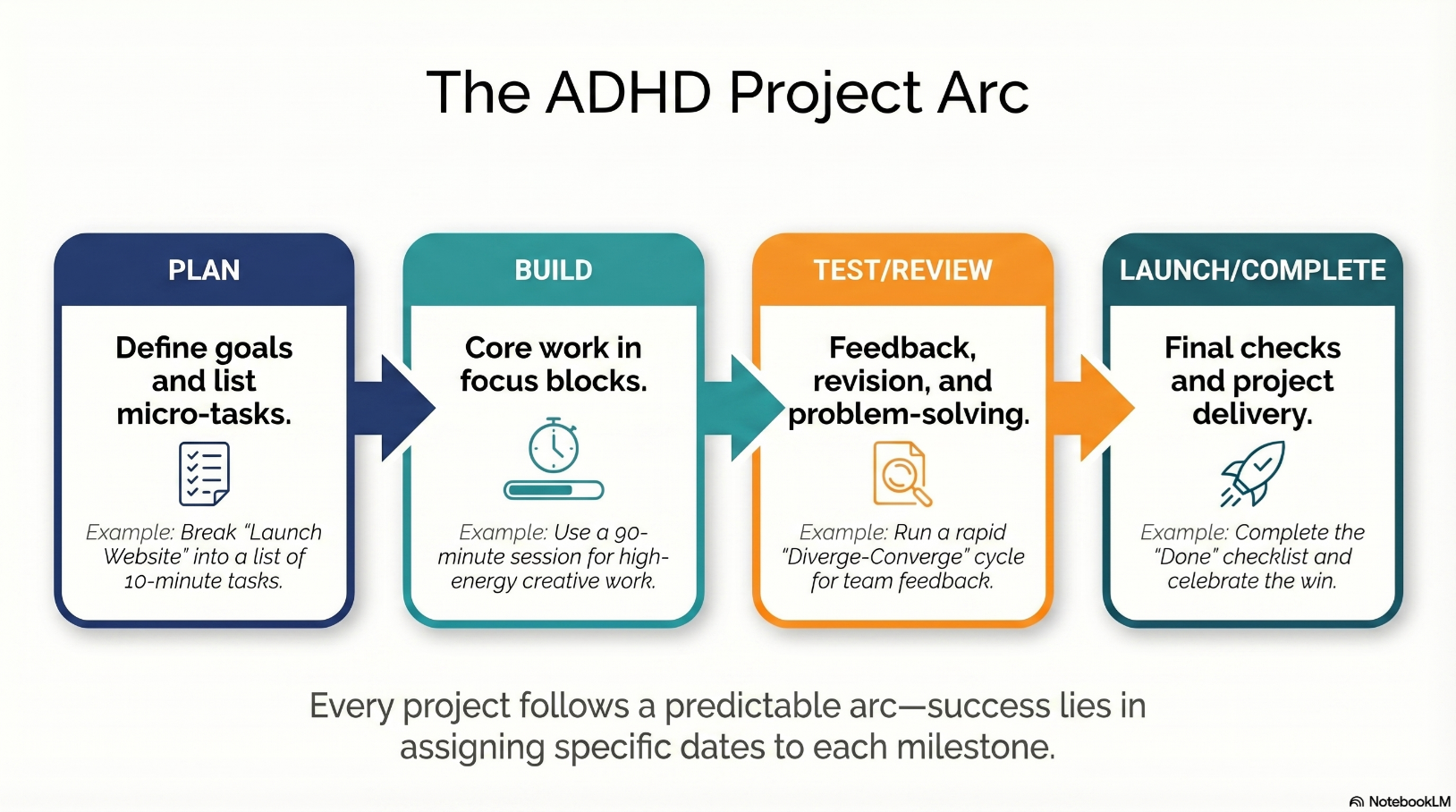
Map any project into four phases with real deadlines so the next step is always concrete.
Learn how to schedule hyperfocus intentionally — your most powerful productivity state — instead of hoping it appears.
Unit 3: Project Planning & Hyperfocus
Unit 4: Money Management for ADHD Entrepreneurs
Build a financial system that runs even on your worst executive function day.
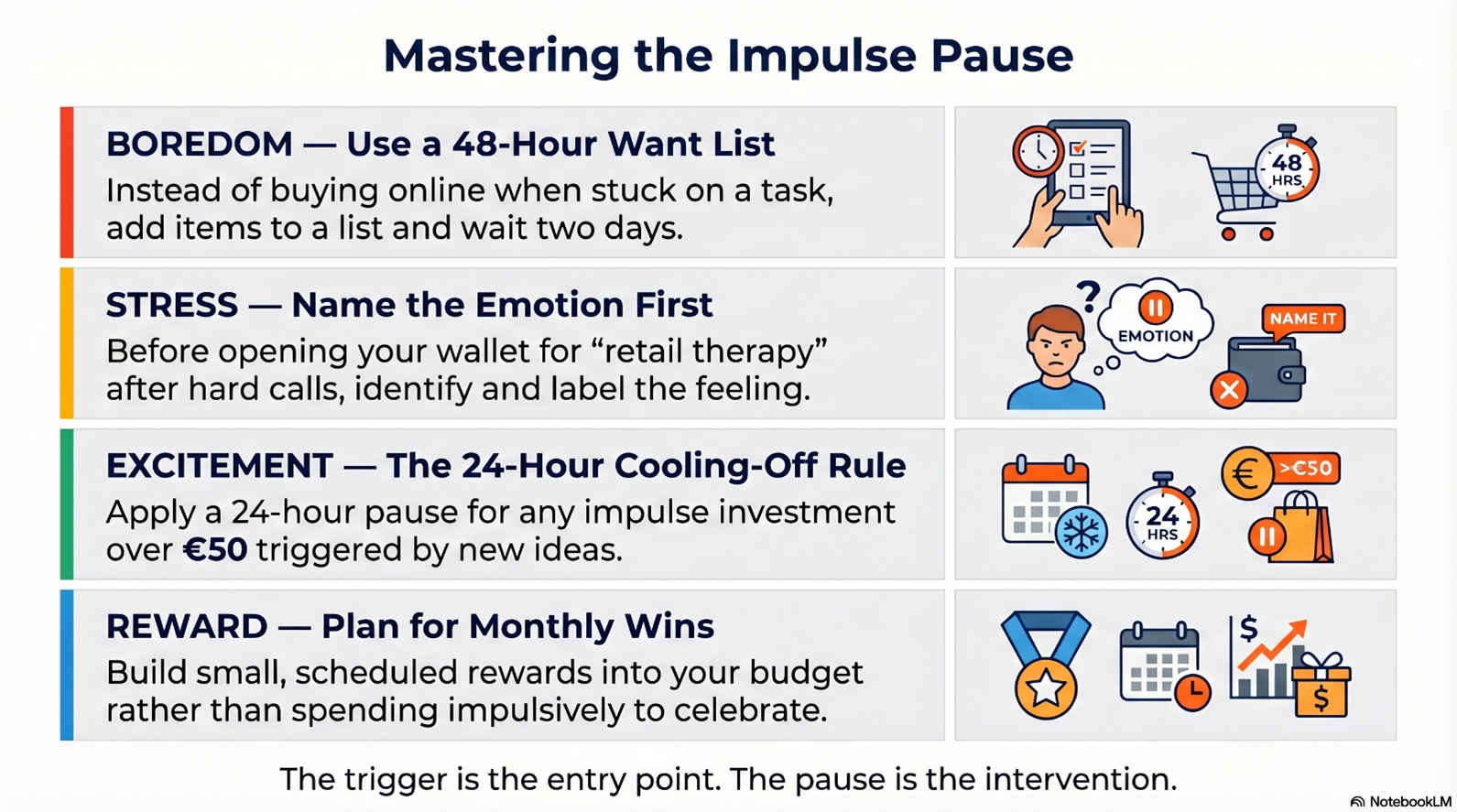
Understand your impulsive spending triggers and how to pause them.
Automate bills, savings, and tracking so your finances work in the background — without you having to remember.



This unit explains why time feels different with ADHD — and gives you concrete tools to take control of your day without relying on willpower or rigid schedules.
Learning Objective: Apply at least one time management technique — time blocking or the Pomodoro Technique — to structure your next working day.
1.1. Introduction to Time Management for Individuals with ADHD
Time management is genuinely harder with ADHD — not because of laziness, but because of time agnosia: the neurological difficulty in accurately perceiving the passage of time. Tasks take longer than expected. Hours disappear. Deadlines appear out of nowhere. This is not a character flaw. The fix is not to try harder to sense time — it is to make time visible using external systems.
Fun Fact: Individuals with ADHD systematically underestimate or overestimate time intervals by up to 20%, contributing to chronic lateness and missed deadlines even when they are trying hard (Toplak & Tannock, 2005).

Case Example Introduction
Meet Maya — a freelance graphic designer with ADHD who is brilliant at creative briefs but constantly battles missed deadlines, a chaotic to-do list, and a bank account that surprises her every month. Look for the orange border on the left side.
Throughout this module, you'll see how Maya builds her personal productivity toolkit — one unit at a time. Watch for her in every unit. Her challenges are probably yours too.
1.2 Understanding Time Agnosia and how to overcome it
A common struggle for those with ADHD is time blindness, also known as time agnosia. This refers to the inability to accurately perceive the passage of time (Cox, 2022).
How-To Overcome Time Agnosia:
1. Use of Visual Timers:
- Tools: Apps like Time Timer or physical timers with visual countdowns.
- Implementation: Set a timer for a dedicated amount of time to complete tasks and visually monitor the remaining time.
2. Leverage Alerts and Reminders:
- Tools: Phone/computer alarms or smartwatch reminders.
Implementation: Schedule reminders for transitions, breaks, and task completions.
3. Create Predictable Routines:
- Use consistent patterns for daily tasks to reduce decision fatigue.
⚡ ACTIVITY — Time-Block Tomorrow
Step 1 — Open your calendar or a piece of paper. Write the three zones for tomorrow: Morning block (your peak energy): one important task — what is it? _______________ Midday block: meetings, emails, admin Afternoon block: one creative or planning task
Step 2 — Add a 15-minute buffer between each block.
Step 3 — Identify one person you could body-double with this week.
Name them: _______________ Method (café / Focusmate / video call): _______________
By leveraging practical tools, techniques, and routines, individuals with ADHD can overcome time management barriers and create a more organized, fulfilling, and productive lifestyle.
The Pomodoro Technique Work for 25 minutes on a single task. Take a 5-minute break. After four cycles, take a longer 15–30 minute break. The fixed endpoint is what makes this work for ADHD — your brain knows it only has to sustain focus until the timer rings. Tool: PomoFocus app (pomofocus.io)
Time Blocking: Divide your day into broad zones aligned with your natural energy. Creative work in the morning. Admin after lunch. Calls in the afternoon. Always add 10–15 minute buffer blocks between zones — this is where the ADHD brain catches up without everything cascading into stress.
The 5-Minute Rule: For tasks you struggle to start, commit to just 5 minutes. Set a timer. Begin. The activation barrier — the hardest moment in any ADHD task cycle — is usually crossed in those first 5 minutes.
Technique | Best For | Hidden Strenght |
|---|---|---|
Pomodoro | Tasks you struggle to start or sustain | Fixed endpoint reduces open-ended dread |
Time Blocking | Full-day planning | Removes constant "what next?" decisions |
5-Minute Rule | Starting anything at all | Bypasses the task initiation block |
Visual Timer | Any focused work session | Makes abstract time concrete and visible |
Buffer Blocks | Between every scheduled block | Absorbs overruns without cascading stress |
1.3 Body Doubling: The Social Focus Hack
Body doubling — working alongside another person physically or virtually — is one of the most effective and underused ADHD focus tools. You don't need to be doing the same task. You don't need to talk. The presence of another person is enough to activate the brain's social reward system and increase sustained attention. Options: work at a café, co-work via Focusmate.com, or call a friend and work in shared silence on video. (Lovering, 2022)

MAYA MOMENT Maya used to start each working day by checking emails "just for a minute." She would look up to find it was 2pm and she had done nothing on the client brief due at 5pm. She tried one change: time blocking her morning with a single rule — no email until 11am. Creative work only, 9–10:30am, with a Pomodoro timer running. Buffer from 10:30–10:45am. Emails from 10:45–11:30am. Three weeks later, she had missed zero deadlines. "The buffer was the magic," she said. "My brain needed permission to be late within the block.
Unit 1 — Reflection Questions:
- What time of day do you feel most naturally focused? What usually kills that focus?
- Have you ever tried working alongside someone — in person or virtually? What happened?
- What would your ideal working day look like if you designed it entirely around your brain?
QUICK CHECK
Can you name the difference between the Pomodoro Technique and time blocking?
Do you know what time of day your energy and focus are naturally highest?
Have you built at least one buffer block into tomorrow's schedule?
→ If yes, you are ready for Unit 2.
"Using a visual timer is an external system that compensates for ADHD time blindness."
TRUE
a) The ability to hyperfocus for long periods
b) Difficulty accurately perceiving the passage of time
c) A technique for breaking tasks into chunks
d) A type of working memory challenge
b) Difficulty accurately perceiving the passage of time




Final Takeaway
"ADHD productivity is not about doing more. It is about designing better systems"

Resource name | Type | Link |
|---|---|---|
Top 10 Tech Tools to Support ADHD and Executive Functioning | Website | |
The Connection Between ADHD and Entrepreneurship | Website | https://www.theminiadhdcoach.com/living-with-adhd/adhd-entrepreneurship |
Brainstorming: An ADHD Power Tool | Website | |
Managing Money and ADHD: Money Management Schedule | Website | https://chadd.org/for-adults/managing-money-and-adhd-money-management-schedule/ |
Those With ADHD Might Make Better Entrepreneurs. Here's Why. | Website |
- Asana Team. (2025). The Eisenhower Matrix: How to prioritize your to-do list. https://asana.com/resources/eisenhower-matrix
- Cox, J. (2022). Time management tips for people with ADHD. PsychCentral. https://psychcentral.com/adhd/time-management-tips-for-people-with-adhd
- Folaron, G. (2024). ADHD in project management. Leantime.
- Gendron, A. (2022). Effective strategies for ADHD money management. The Mini ADHD Coach.
- Guy-Evans, O. (2024). ADHD hyperfocus. Simply Psychology.
- Hupfeld, K. E., Abagis, T. R., & Shah, P. (2018). Living "in the zone": Hyperfocus in adult ADHD. ADHD Attention Deficit and Hyperactivity Disorders, 11(2), 191–208.
- LaMarco, N. (2023). Productivity with ADHD. Inflow.
- Lovering, N. (2022). ADHD body doubling. PsychCentral.
- Neurolaunch team. (2024). Mind mapping for ADHD. Neurolaunch.
- Toplak, M. E., & Tannock, R. (2005). Time perception in attention-deficit/hyperactivity disorder. Journal of Abnormal Child Psychology, 33(5), 639–654.
DRIVE is designed to empower ADHD entrepreneurs. We offer tailored support, resources, and training programs that leverage the unique strengths of ADHD minds.
Our mission is to help individuals with ADHD develop their entrepreneurial skills, overcome common challenges, and build successful businesses.
The project started 01/10/2024, and the end date is 30/09/2026. Project reference number: Erasmus+ KA220 - 2024-1-CZ01-KA220-VET-000248121. The project is realized by international partners with various backgrounds (see more in the section “Partners”)

Funded by the European Union. Views and opinions expressed are however those of the author(s) only and do not necessarily reflect those of the European Union or the European Education and Culture Executive Agency (EACEA). Neither the European Union nor EACEA can be held responsible for them.
Have questions or interested in collaborating?
We'd love to hear from you! Project coordinator: Dr. Jana Pitrova, pitrovaj@pef.czu.cz
Please select your language for the country specific contacts.