


Welcome to Module 5: Stronger Together.
(Estimated learning time: 55 min)
Your ADHD brain does its best work inside the right structure — and the right people. In this module, you will build the support network your business actually needs.
Core Objectives
By the end of this module, you will be able to:
- Identify the business and emotional benefits of ADHD-affirming communities.
- Apply actionable strategies to build and strengthen your professional support networks.
- Develop effective communication and self-advocacy skills, especially when asking for help or accommodations.
- Differentiate between peer and expert mentorship models, and select the approach that aligns with your current business stage.
- Implement structured, ADHD-friendly support formats like co-working, accountability groups, and body doubling.
Unit 1: Building ADHD-Affirming Business Communities
Understanding the cost of isolation, Navigating Rejection Sensitive Dysphoria (RSD),
Finding or creating professional spaces that celebrate neurodiversity.
Unit 1: Building ADHD-Affirming Business Communities
Unit 2: Communication, Self-Advocacy, and Interpersonal Skills
Learning how to clearly articulate your needs, pitch your ideas confidently, and ask for help using "Minimum Viable Structure" without feeling shame.
Unit 3: Building ADHD-Affirming Business Communities
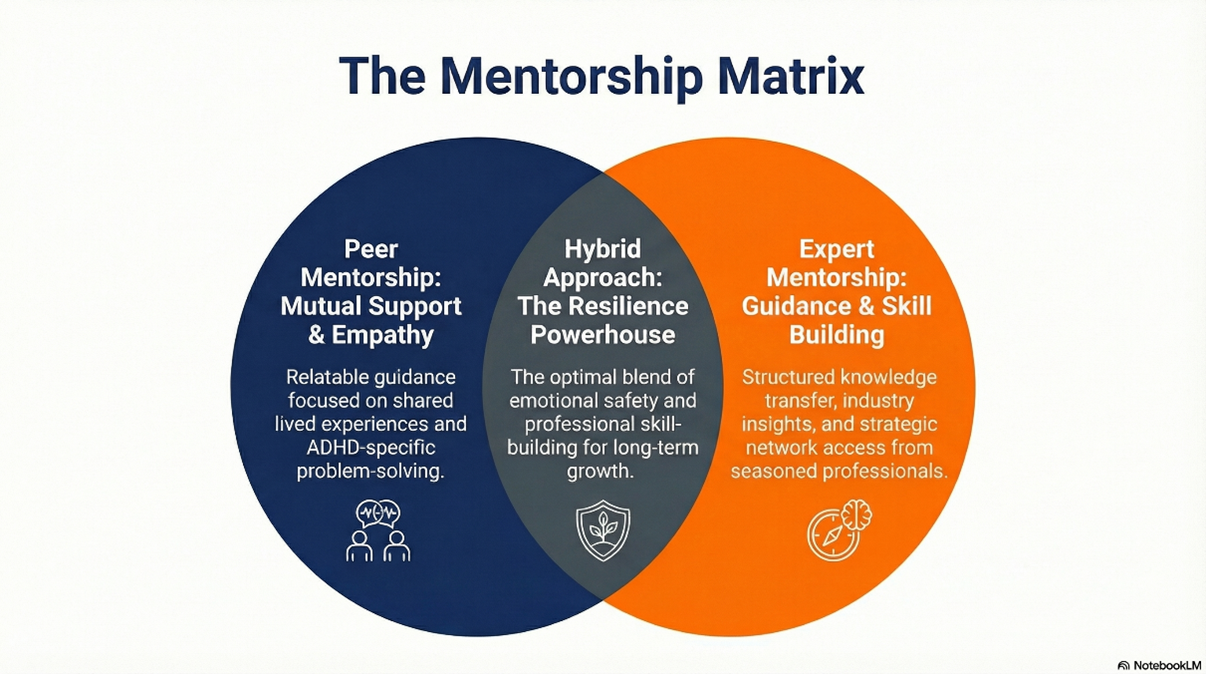
Mentorship Frameworks: Peer-to-Peer and Expert Models
Co-working, Accountability Groups, and Support Circles
Unit 3: Building ADHD-Affirming Business Communities
Case Example Introduction
Meet Marco: is an ADHD entrepreneur running a small creative agency. He has a high-energy, ideas-first approach that wins clients — but he struggles with isolation, inconsistent follow-through, and asking for help before problems escalate. Look for the orange border on the left side.
Throughout this module, you'll see how Marco uses each tool and community strategy to stop going it alone. Watch for him in every unit. His pattern is probably yours too.
1.1. Finding and Creating ADHD-Friendly Business Communities
Social Capital Theory, as defined by Bourdieu (1986) and later expanded by Putnam (2000), refers to the networks, norms, and trust that enable people to work together more effectively.
Social capital is simply what you experience as: having someone who gets it, having a space where asking for help is normal, and having peers who help you think through the stuck points.
The Social Capital Theory can be applied in the following steps:
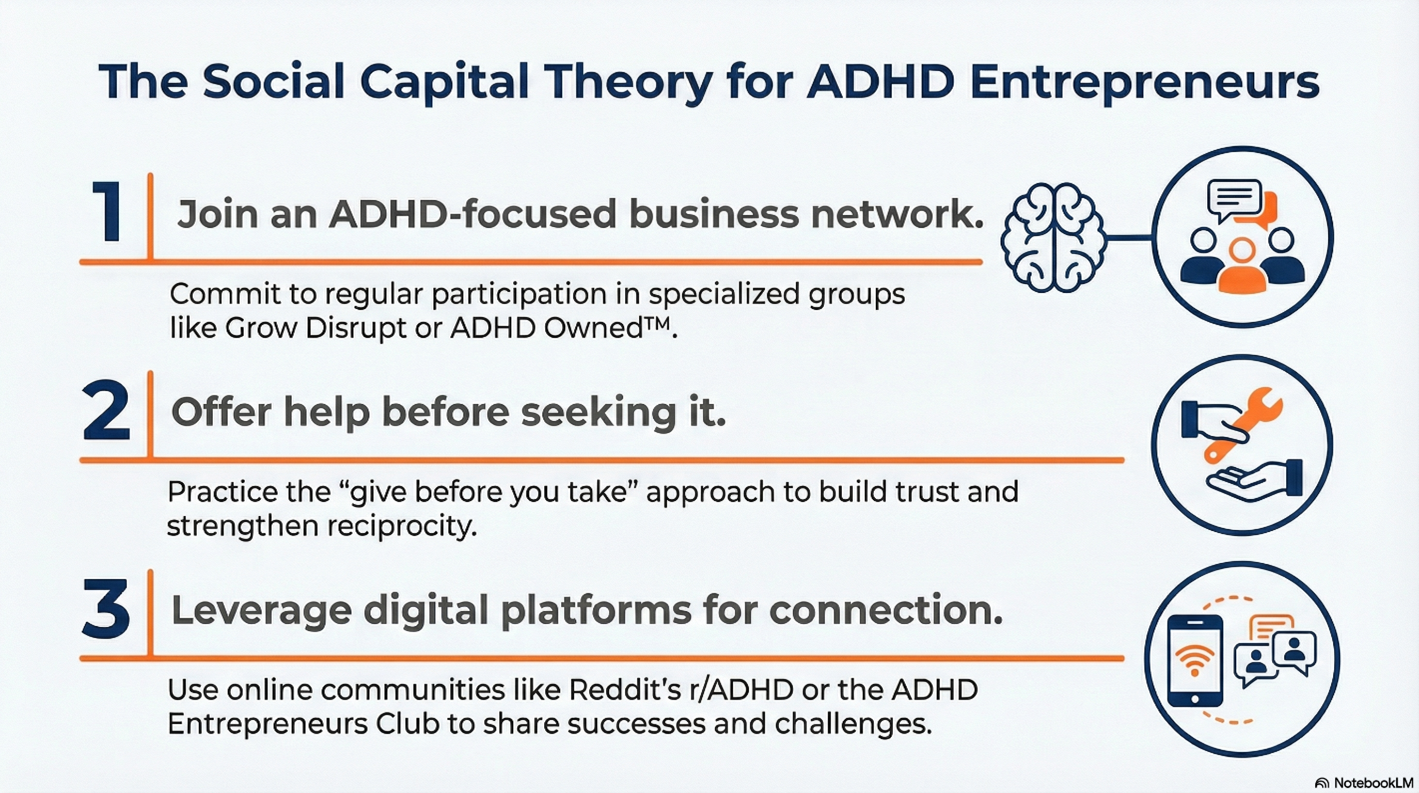
Fun Fact: ADHD entrepreneurs who participate in structured peer communities report
a 40% reduction in feelings of professional isolation compared to those who work alone (Putnam, 2000).
Community Name | Main Focus | Unique Benefit |
|---|---|---|
Grow Disrupt (https://www.growdisrupt.com) | Business development & events | Tailored events for ADHD entrepreneurs to foster growth |
ADHD Owned™ (https://adhdowned.com) | Coaching, education, support | Yearly program providing fellowship & mentorship |
ADHD Entrepreneurs Club (https://adhdinbiz.com) | Freelancer & small business networking | Peer support & shared achievement recognition |
DIY Genius (https://www.diygenius.com) | Mindful productivity strategies | Helps build ADHD-friendly work habits |
These communities offer practical strategies and resources but also foster environments where ADHD entrepreneurs can feel understood and supported. By connecting with peers who share similar experiences, individuals can gain valuable insights, build confidence, and develop sustainable business practices that align with their unique strengths.
COMMUNITY SCAN SPRINT — 5 minutes
Open your browser. Search: "ADHD entrepreneur community" + one word that describes your industry (e.g. "ADHD entrepreneur community + freelance" or "+ design" or "+ e-commerce").
Rule: No signing up yet. Just look.
Write down: the name of one community that feels like it was built for someone like you. That is your Week 1 community target.
1.2. How to Ask for Help: Developing Communication and Interpersonal Skills
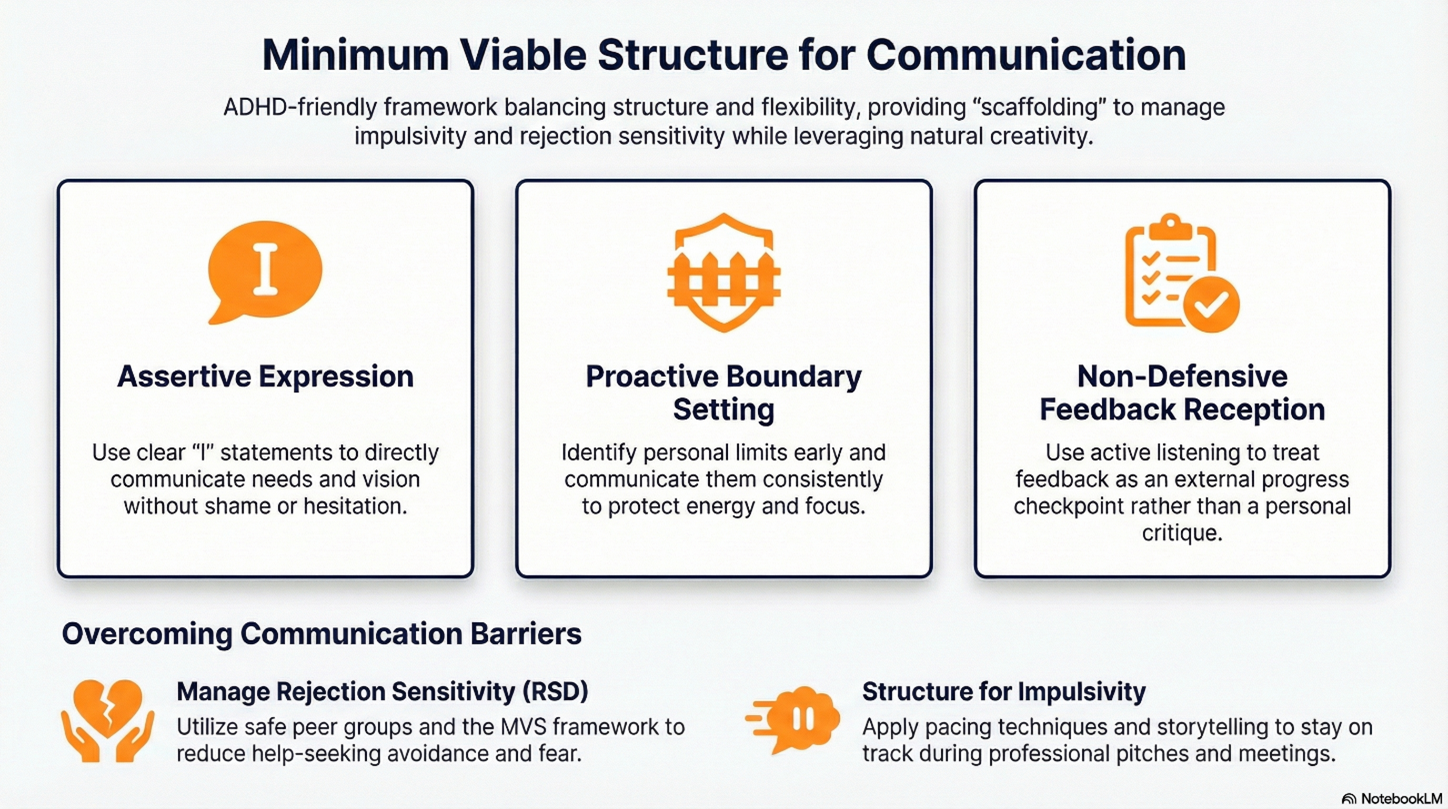
For many ADHD entrepreneurs, seeking assistance can be challenging. Caren Magill of "It's ADHD Friendly" discusses the importance of creating systems that align with the ADHD brain, emphasizing that traditional methods may not always be effective. She advocates for the "Minimum Viable Structure" approach, which balances structure and flexibility, making it easier for individuals to seek and offer help within their communities (It’s ADHD Friendly).

Fun Fact: Up to 70% of individuals with ADHD experience Rejection Sensitive Dysphoria — making structured, low-judgment peer environments especially critical for help-seeking behaviour (Cleveland Clinic, 2022).
To adress those issues, we wrote down few strategies that might help:
Skill | What it means | Quick practice |
|---|---|---|
Assertiveness | Express your needs directly and respectfully | Say "I need X to do my best work" — not "Sorry to bother you but maybe…" |
Boundary Setting | Identify your limits and communicate them clearly | Write one work boundary this week. Say it aloud once before you send it (ADD Resource Center, 2024). |
Feedback Reception | Hear feedback without shutting down | Ask "What's one thing I could do differently?" instead of waiting to be told. |
But you don't need therapy to start. The three skills under can be practised today, in small doses, inside a safe peer group.
Marco Moment: Marco had been putting off messaging three people in his network about his agency's capacity issues. He used the Assertiveness script: 'I need X to do my best work.' He sent three messages in one morning. Two people responded within the day — one referred him a new client. 'I'd been sitting on this for six weeks,' he said. 'The script made it feel safe to just say the actual thing.
Quick Check ✓
Can you name: (1) one ADHD community you will look at this week? (2) one communication skill you will practise? If yes — you are ready for Unit 2.
Unit 1 — Reflection Questions:
• Which of the ADHD-affirming communities listed in this unit felt most relevant to where you are right now?
• When was the last time you asked for help before a problem became a crisis — and what made that possible (or impossible)?
• What is one boundary or communication habit you want to practise this week?
You now have a target community and a framework for asking for help. Time to put both to work — Unit 2 is about making sure people actually hear you.
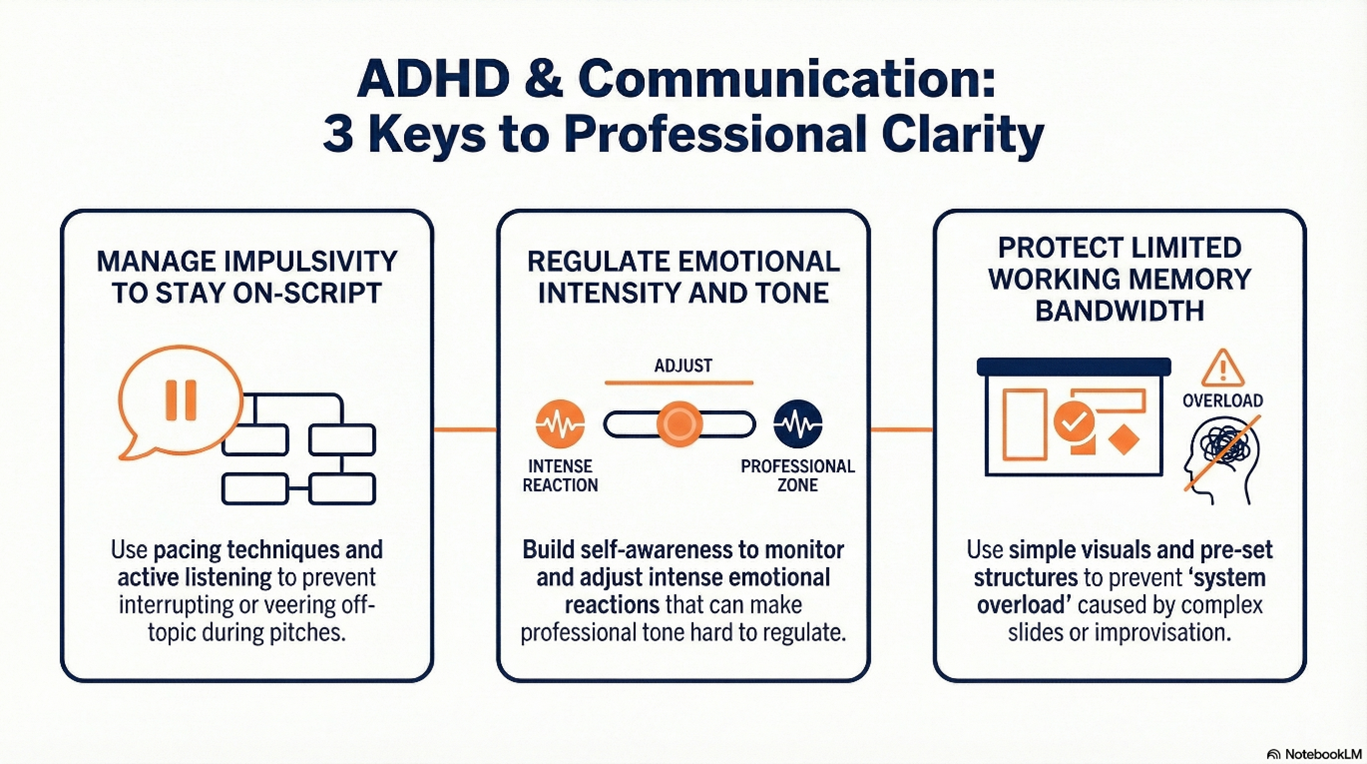





Final Takeaway
"You don’t have to do ADHD alone – and you don’t have to mask it to succeed."
Resource name | Type | Link |
|---|---|---|
ADHD Coaches Organisation — Support Groups & Workshops | Website | |
ADHD Owned™ — Coaching & Community for ADHD Entrepreneurs | Website | |
Multimedia Learning in ADHD Students (Zwijnenburg, 2024) | ||
ADHD Entrepreneurs Club (ADHD In Biz) | Website | |
Communication | online article | Mastering Nonverbal Communication When You Have ADHD – ADD Resource Center |
- Cleveland Clinic. (n.d.). Rejection sensitive dysphoria (RSD): Symptoms & treatment. Retrieved from https://my.clevelandclinic.org/health/diseases/24099-rejection-sensitive-dysphoria-rsd
- Deepwrk. (n.d.). ADHD-friendly co-working and focus sessions. Retrieved from https://www.deepwrk.io
- Diamond, A. (2025). Executive function and cognitive flexibility in ADHD. Journal of Cognitive Enhancement.
- Duh-Leong, C., Dreyer, B. P., Huang, T. T-K., Katzow, M., Gross, R. S., Fierman, A. H., Tomopoulos, S., Di Caprio, C., & Yin, H. S. (2021). Social capital as a positive social determinant of health: A narrative review. Academic Pediatrics, 21(4), 594–599. https://doi.org/10.1016/j.acap.2020.09.013
- Dyad. (2024). Peer vs. traditional mentorship for professional growth. Retrieved from https://www.dyadhq.com/post/peer-vs-traditional-mentorship-for-professional-growth
- ElBarazi, A. S., et al. (2024). Efficiency of assertiveness training on the stress, anxiety, and depression levels of college students: Randomized control trial. Journal of Education and Health Promotion, 13, 203. https://doi.org/10.4103/jehp.jehp_264_23
- Graven, M., & Lerman, S. (2003). Wenger, E. (1998). Communities of practice: Learning, meaning and identity. ResearchGate. https://www.researchgate.net/publication/225256730
- Manos, M. (2025). Body doubling and ADHD: Productivity through presence.
- Mentorloop. (2024). Modern mentoring: Traditional mentors vs. accountability partners. Retrieved from https://mentorloop.com/blog/accountability-partners/
- Ollington, N. (2024). ADHD and communication in entrepreneurship. Neurodiverse Business Journal.
- Pearce, R. (2024). Accountability systems for ADHD professionals.
- Putnam, R. D. (2000). Bowling alone: The collapse and revival of American community. Simon & Schuster.
- Superpower Mentors. (n.d.). Neurodiverse mentoring vs coaching. Retrieved from https://www.superpowermentors.com/post/neurodiverse-mentoring-vs-coaching
- Untapped Learning. (n.d.). Home. Retrieved from https://untappedlearning.com/
- Wenger, E. (1998). Communities of practice: Learning, meaning, and identity. Cambridge University Press.
- Zwijnenburg, M. (2024). Effective presentation tools for ADHD entrepreneurs. Visual Learning & ADHD Quarterly.
DRIVE is designed to empower ADHD entrepreneurs. We offer tailored support, resources, and training programs that leverage the unique strengths of ADHD minds.
Our mission is to help individuals with ADHD develop their entrepreneurial skills, overcome common challenges, and build successful businesses.
The project started 01/10/2024, and the end date is 31/12/2026. Project reference number: Erasmus+ KA220 - 2024-1-CZ01-KA220-VET-000248121. The project is realized by international partners with various backgrounds (see more in the section “Partners”)

Funded by the European Union. Views and opinions expressed are however those of the author(s) only and do not necessarily reflect those of the European Union or the European Education and Culture Executive Agency (EACEA). Neither the European Union nor EACEA can be held responsible for them.
Have questions or interested in collaborating?
We'd love to hear from you! Project coordinator: Dr. Jana Pitrova, pitrovaj@pef.czu.cz
Please select your language for the country specific contacts.