

Welcome to Module 4: Stronger in Every Step.
Stress is a universal experience. But for people with ADHD, it often arrives faster, hits harder, and takes longer to recover from. This module helps you recognise your early warning signals, understand what is happening in your brain when stress escalates, and build a personalised toolkit of regulation strategies that actually work for an ADHD mind.
Core Objectives
By the end of this module, you will be able to:
- Recognise the signs of emotional dysregulation and burnout specific to ADHD — and understand the neurological reasons they occur.
- Understand the Window of Tolerance concept and identify when you are inside or outside your optimal arousal zone.
- Apply a personal stress toolkit across four categories of regulation strategies — body-based, action-based, sensory, and cognitive.
- Build emotional resilience through practical habits, compassionate self-talk, and small-win tracking.
- Identify when and how to seek professional or peer support — and take that step without shame.
Unit 1: Recognizing Emotional Dysregulation and Burnout in ADHD
Why emotions can feel intense
Early signs of burnout
Understanding high and low arousal (Window of Tolerance)
By the end, you will recognize stress signals and use self-awareness to manage your emotions
Unit 1: Recognizing Emotional Dysregulation and Burnout in ADHD
Unit 2: Tools for Stress Management & Emotional Regulation
Why stress feels different with ADHD
Exploring a toolkit of regulation strategies
Choosing and applying tools that fit your needs
By the end, you will be able to identify stress patterns and use at least one effective regulation tool.
Unit 3: Building Resilience & Seeking Support
What resilience is and why it matters
Tools to strengthen emotional resilience
Knowing when to seek help
By the end, you will be able to use resilience tools and reach out for support when needed.
Unit 3: Building Resilience & Seeking Support


This unit explains what emotional dysregulation actually is, why it is neurological rather than personal, and how to recognise the signs of burnout before it takes you down completely.
Learning Objective: Identify your personal emotional dysregulation signs and at least three early burnout signals — and understand the neurological reason both happen more intensely with ADHD.
Case Example Introduction
Sam — a freelance UX consultant with ADHD who runs a small design studio. Sam is creative, fast-thinking, and deeply committed to every client project. But Sam also experiences intense emotional reactions to critical feedback, regularly pushes through exhaustion until burnout forces a stop, and finds it almost impossible to ask for help before things reach crisis point. Look for the orange border on the left side.
Throughout this module, you will see how Sam learns to recognise stress earlier, builds a regulation toolkit that fits the way their brain works, and finally starts treating rest as strategy rather than failure.
1.1 Emotional Dysregulation and ADHD: Why Emotions Feel So Intense
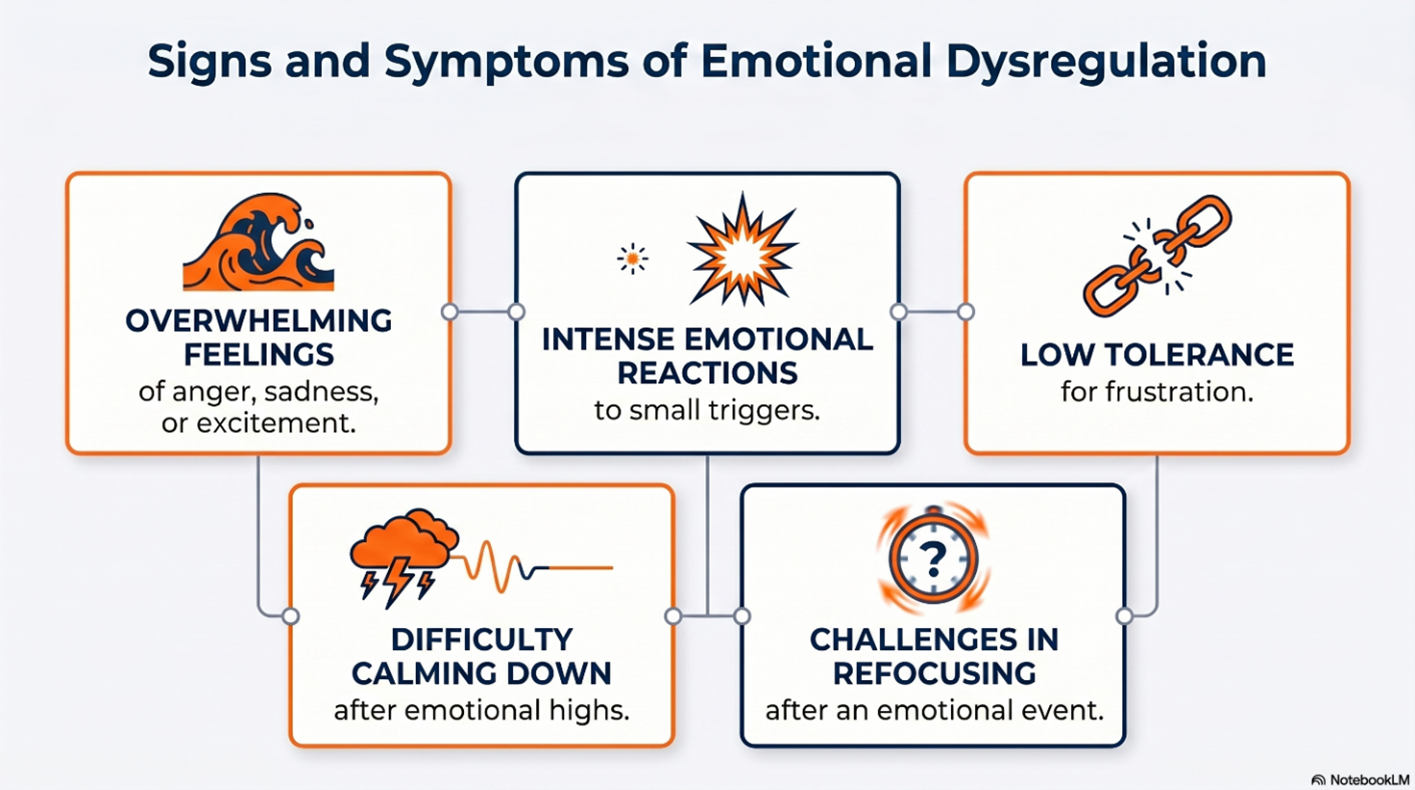
People with ADHD often experience emotions more intensely and more rapidly than others. This is called emotional dysregulation. It is a core feature of ADHD, not just a side effect.
Fun Fact: Up to 70% of adults with ADHD experience significant emotional dysregulation as a core neurological feature — not just a side effect. This is linked to reduced prefrontal cortex activity and lower baseline dopamine, both of which affect how quickly emotions escalate and how long they take to resolve. (Shaw et al., 2014)

You might get very frustrated over a minor mistake at work, or feel suddenly sad without a clear reason. These strong emotions can make it hard to focus, solve problems, or respond calmly.
This is not about being “too sensitive” or lacking emotional intelligence. It reflects how the ADHD brain processes stimuli and reacts to stress. The same brain mechanisms that affect attention, impulse control, and motivation also affect emotional regulation. Understanding these patterns helps you notice when you are nearing your limits. It also allows you to use tools early, before emotions spiral or burnout occurs.
1.2 Signs of ADHD-related burnout
Burnout is especially common among people with ADHD — not because they are less capable, but because their brains carry a heavier mental load every day. Lower dopamine means more effort is required just to start tasks. Executive function challenges demand constant self-management. Emotional reactivity makes stress hit harder. And the ongoing pressure to mask and compensate in systems designed for neurotypical brains creates a cumulative exhaustion that builds quietly until it doesn't.
Understanding these overlapping stress factors is key to preventing burnout. With right tools, support, and self-awareness, it’s possible to manage these challenges and protect mental energy.

Burnout often develops gradually. Recognizing early signs is crucial for seeking support and preventing the situation from worsening. One warning sign is constant exhaustion, even after getting enough rest. This can mean that the level of stress has surpassed your ability to recover. Another sign is losing interest and motivation in activities or work that once felt meaningful. This shows that your enthusiasm and sense of purpose are being affected.
Burnout can also appear as difficulty with organizing and focusing. Daily routines may start to feel unmanageable, which can increase frustration and lead to procrastination.

Emotional strain may show as increased irritability and more frequent emotional outbursts.
Burnout Signal | What It Looks Like |
|---|---|
Chronic exhaustion | Tired even after rest. Brain feels foggy or overloaded. |
Losing interest | Tasks that once motivated you now feel pointless or burdensome. |
Trouble concentrating | Basic planning and follow-through become difficult. Procrastination increases. |
Increased irritability | Patience is shorter. Emotional outbursts become more frequent. |
Numbness or disconnection | Emotional shutdown, withdrawal from others, loss of meaning or purpose. |
1.3 The Window of Tolerance: Understanding Arousal Levels
The Window of Tolerance describes the range of emotional and physiological arousal in which we can function optimally. Inside this window, we’re able to regulate emotions, think clearly, engage socially, and learn effectively.

Thermometer scale showing three arousal states: hypoarousal (low energy), optimal arousal (balanced energy), and hyperarousal (high energy):
- Within the window → Calm, focused, emotionally present
- Hyperarousal → Heightened alertness, anxiety, anger, restlessness
- Hypoarousal → Numbness, fatigue, disconnection, emotional shutdown
For people with ADHD, the window is often narrower and more easily disrupted due to challenges in self-regulation and sensory sensitivity.
Mild hyperarousal is not the enemy — it is what gets you out of bed and meets a deadline. The problem is when it becomes prolonged or extreme. For ADHD brains, stressful situations involving time pressure, sensory overload, or social conflict can push arousal to extremes faster than average — and returning to baseline takes longer. The goal is not to stay perfectly calm. It is to notice when you have left your window early enough to act.
✍️ TRY THIS NOW: If-Then Self-Reflection — ⏱️ 5 minutes Activity
Read each prompt. Write your personal version of each response.
If I notice physical signs (e.g. tension, faster breathing, quickened speech, urge to withdraw) → Then I may be: _______________
If I notice these external triggers (e.g. deadlines, criticism, noise, unclear instructions) → Then I tend to: _______________
If I notice restlessness, agitation, or anxiety (hyperarousal) → Then I will try: _______________
If I notice numbness, fogginess, or shutting down (hypoarousal) → Then I will try:
SAM MOMENT Sam used to describe their stress response as "going from zero to nuclear in about thirty seconds." A client's short, ambiguous email could ruin an entire afternoon. Sam had no idea this was rejection sensitivity — they thought it was just being oversensitive and unprofessional. Learning the Window of Tolerance changed this. "When I feel that spike," Sam said, "I now recognise it as hyperarousal — not a crisis. I have a name for it. Naming it gives me about a five-second gap before I react. That five seconds is everything."
Unit 1 — Reflection Questions
- Think about the last time you felt emotionally overwhelmed. What was the trigger? How did your body feel before you noticed the emotion?
- Which of the five dysregulation signs from section 1.1 feels most familiar to you?
- How long does it typically take you to return to baseline after a stressful event? What helps — or doesn't help?
QUICK CHECK
- Can you name three of your personal early warning signs for stress or overload?
- Can you describe what hyperarousal and hypoarousal feel like in your own body?
- Do you know at least one situation that reliably pushes you outside your Window of Tolerance?
- → If yes, you are ready for Unit 2.
1.6. Activity: Spot the narrative: Deficit vs Neuroaffirmative
Language shapes how we view ourselves and others. When we talk about ADHD, we often hear deficit-based language words that highlight what a person lacks or fails at. In contrast, a neuroaffirmative perspective acknowledges that brains work differently, not wrongly. It recognises strengths, values diversity in thinking, and avoids framing differences as flaws.
Activity Instructions:
Below are two short scripts. One uses deficit-based language, the other is neuroaffirmative.
Your task: Identify which is which and write in the box if its neuroaffirmative or deficit based and what the key words or phrases that gave it away.
Script A
"She/He/They never finish anything on time. She is always distracted, and it feels like she just doesn’t care. If she could just try harder and be more organised, she'd get more done."
Script B
"She works best when she's interested and thrives in fast-paced settings. While structured deadlines are tricky, she brings creativity and energy to projects that excite her."
"Burnout in ADHD can develop gradually, driven not just by overwork but by the cumulative cost of masking, emotional recovery, and executive function demands."
TRUE
a) Consistently calm reactions to stress
b) Sudden mood changes without a clear external trigger
c) High tolerance for criticism and feedback
d) Absence of emotional responses under pressure
b) Sudden mood changes without a clear external trigger






DRIVE is designed to empower ADHD entrepreneurs. We offer tailored support, resources, and training programs that leverage the unique strengths of ADHD minds.
Our mission is to help individuals with ADHD develop their entrepreneurial skills, overcome common challenges, and build successful businesses.
The project started 01/10/2024, and the end date is 30/09/2026. Project reference number: Erasmus+ KA220 - 2024-1-CZ01-KA220-VET-000248121. The project is realized by international partners with various backgrounds (see more in the section “Partners”)

Funded by the European Union. Views and opinions expressed are however those of the author(s) only and do not necessarily reflect those of the European Union or the European Education and Culture Executive Agency (EACEA). Neither the European Union nor EACEA can be held responsible for them.
Have questions or interested in collaborating?
We'd love to hear from you! Project coordinator: Dr. Jana Pitrova, pitrovaj@pef.czu.cz
Please select your language for the country specific contacts.